Medical Device Connectivity With Purpose
What is the purpose of medical device connectivity? While most healthcare professionals would agree that connectivity is important, it is not often the end goal of a project. Medical device connectivity solutions are designed to share information with other technologies — typically with the goal of supporting a clinical or operational outcome for patients and care teams.
Of course, as connected device implementations become more complex, keeping those higher purposes in mind can prove challenging. How can healthcare teams choose connected health solutions that support IT and clinical workflow integration? Read on for our experts’ advice on five steps to connectivity projects that support high-quality, efficient patient care delivery — at go-live and beyond.
Step 1: Map the Clinical Workflow to Identify Integration Opportunities

The first step is to begin with a clear understanding of the problem you are trying to solve. Create a strong foundation for your device integration project by taking a deep dive into the current clinical workflow. Then, and only then, can you evaluate potential changes that could help you address the challenge — and consider how those changes may lead to others (intentional or not). Najia Khawar, Senior Director, Baxter Project Management Office, explains:
“When we integrate a medical device into a workflow, we start by mapping out the entire process,” says Khawar. “Many times, one change leads to others. The best time to identify these issues is early on — so clinical and IT teams need to come together to fully flesh out the new process.”
Clinical workflow mapping is an important first step in aligning connectivity solutions with the purpose behind your project.
Step 2: Leverage Device Connectivity to Automate Manual Tasks

After identifying what changes are needed for a certain workflow, consider all the ways the connected medical device could automate routine tasks and take manual processes off clinicians’ hands.
“Our goal for automation is typically to reduce steps and reduce redundancy,” says Mary Reagan-Zingler BSN, RN, Senior Manager, Baxter Enterprise Strategy & Informatics. “For example, if clinicians are documenting data in multiple ways — perhaps recording vital signs on a sticky note and then transferring them to the EMR later — we can leverage EMR integration so the clinician can spend their time on activities that are more meaningful for their patients and themselves.”
Consider all the ways automation could help your patients and care teams. From satisfaction to return on investment and beyond, the possibilities are growing every day.
Step 3: Test Workflow Changes in Realistic Scenarios

Once all teams align on a new workflow, it’s time for testing. While it may be tempting to skip this step when timelines are tight, workflow testing is an essential part of a successful device integration project. Whether you have a full simulation center or you’re staging scenarios in a biomed room, when it comes to testing, more is better.
“You want to make your workflow testing scenarios as rigorous as possible,” advises Khawar. “Aim for high volume and cover every use case. This is the time to break things and find failure points. See what happens in a testing environment before rolling it out to the broader hospital.”
Step 4: Plan Inclusive, Timely Training for All Stakeholders

Staff training can seem easy to deprioritize during a connected device implementation — yet this crucial step is where many projects succeed or fail. Workflow adoption depends upon strong training plans that put thoughtful consideration into topics and timing — as well as who is involved.
“Timing of training is important,” notes Khawar. “Your teams will need robust support in the early days, helping them accept new technologies and become comfortable with different workflows. Also make sure you’re thinking through all the people who need training. Non-clinical team members like EVS or transport may need to change their workflows as well, and leaving them out of training can create unnecessary hiccups during roll-out.”
Who Needs Training?Think beyond nurses and physicians when creating a training plan. Other affected roles may include: • Certified nursing assistants |
Step 5: Measure Your Return on Investment in Many Ways

Hard costs are crucial elements of any return on investment (ROI) calculation. However, other benefits like time savings, documentation accuracy/efficiency and clinician satisfaction can also have powerful impacts on your bottom line.
“Don’t underestimate the importance of staff satisfaction and time savings as part of your ROI,” says Reagan-Zingler. “They can both contribute greatly to retention, recruitment and workforce strategies.”
Learn more about measuring ROI in healthcare >
Redefine Healthcare Delivery with Meaningful Connectivity
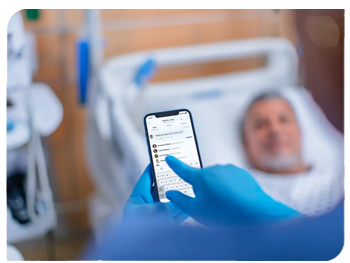
Connecting medical devices into a clinical workflow is about more than technology. It’s about connecting patients and care teams to the information they need, when and where they need it. And at Baxter, it’s an important part of how we are working to redefine healthcare delivery. Explore our connected health solutions and contact us to learn how medical device connectivity solutions can help support your purpose.
Featured Contributors

Najia Khawar, Senior Director, Baxter Project Management Office | Baxter
At Baxter, Najia leads a national PMO overseeing complex healthcare technology deployments across hospitals and health systems. With over 15 years of experience in healthcare operations and digital transformation, she specializes in… Read Full Bio

Ryan Hochworter, Head of Digital Solutions | Baxter
Ryan is a healthcare leader with over 20 years of experience driving digital transformation. At Baxter, he leads teams that develop technology-enabled strategies to address clinical complexity, healthcare value, and accessibility. Ryan has worked with...Read Full Bio
Keep Exploring



Frequently Asked Questions
+ What is medical device connectivity and why is it important in healthcare? |
| Medical device connectivity refers to the ability of devices like monitors, pumps and other diagnostic tools to communicate data to an electronic medical record (EMR) or other connected health solution. It is an important way to help improve clinical workflow efficiency, reduce manual data entry and deliver accurate, timely information to care teams. |
+ How can medical device integration improve clinical workflows? |
| By integrating devices with EMR systems, hospitals can support initiatives like streamlining data collection, reducing documentation errors and freeing up clinicians to focus on patient care. This can help improve both accuracy and time management within workflows. |
+ What types of automation are enabled by connected medical devices? |
| Connected medical devices can automate tasks like vital signs capture, medication infusion tracking, alarm notifications, charting and more. These types of automation can help reduce redundant tasks and support clinical decision-making. |
+ What are common challenges in implementing device connectivity? |
| Key challenges may include interoperability issues, cybersecurity concerns, lack of staff training and integration with legacy EMR systems. Early planning and cross-functional collaboration are essential to help overcome these barriers. |